Sydney, Australia
Australian Council for Educational Leaders Early Years Conference.

After five years of being holed up in my wee home office, my hard work had paid off and here I was on the cusp of being the key note speaker at the Australian Council for Educational Leaders Early Years Conference.
I still find it all a little bemusing or indeed amusing that wee Jane Robertson who was middle of the road at school has achieved this amazing thing and has been invited half way around the world to talk about it. But there you have it, I have and I was.
So after a fabulous week visiting all the sights that Sydney has to offer and climbing the Sydney Harbour Bridge (another amazing thing - I have never been a fan of heights my whole life and I did this amazing climb which involved climbing up a very high bridge with a very big drop below!

But this is the new me! The one who is fearless and does things that she could never have contemplated before. The one who says Yes to things once thought impossible. I have to say that often gets me into situations that I question afterwards but life is for living and I am living it to the full right now!
We visited the Museum of Contemporary Art and there was a fantastic exhibition on by Tracey Whiskey a young aboriginal artist. She used the medium of dot painting and many of her paintings had love as a theme throughout.

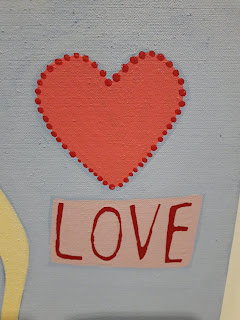
There was also an exhibition of paintings from very young artists depicting relationships that were special to them. These two really drew me in.


We visited the Museum of Contemporary Art and there was a fantastic exhibition on by Tracey Whiskey a young aboriginal artist. She used the medium of dot painting and many of her paintings had love as a theme throughout.


There was also an exhibition of paintings from very young artists depicting relationships that were special to them. These two really drew me in.


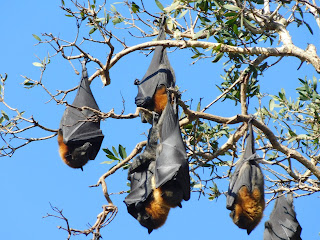
Andy and I had an amazing week of visiting gorgeous beaches, stunning views and saw tons of Aussie wildlife. Including the bats -



All too soon it was time to get to work and do what I came here for! Give my key note at the ACEL early years conference.
The first thing I did was spend time with staff and practitioners from the New South Wales Dept of Education. Tracy Mackey, Executive Director of Early Childhood Education took me to visit Wanibiri Pre-School Nursery which provided childcare for children primarily from indigenous families in Redfern, Sydney. It was a wonderful experience. The children, as children are the world over, were curious about their visitor and came over and chatted to me. The staff were lovely and I learned a little about the cultural activities and experiences the children had as part of their nursery day.


I shared my research with around 20 delegates at the Dept of Education, NSW Govt and challenged them to think about love-led practice. The questions came thick and fast, and a great discussion was had by all. As always the phrase "but some children are too hard to love" came up. As this was the title of my key note presentation, I was happy to challenge delegates to reflect upon why they felt that there might be a child who they felt unable to love. As always delegates rose to the challenge of thinking deeply about the implications of this.
The following day was day one of the ACEL conference. I wasn't due to speak until the second day so I had the pleasure of listening to other speakers. The speakers were all inspiring and motivational, no pressure on me to perform on day two then! We also had a visit from B1 and B2, a spectacle that only an early years conference could provide!


I am hoping to get a recording of my key note, which would be fabby so that I can share it with everyone. Watch this space!


All too soon it was time to get to work and do what I came here for! Give my key note at the ACEL early years conference.
The first thing I did was spend time with staff and practitioners from the New South Wales Dept of Education. Tracy Mackey, Executive Director of Early Childhood Education took me to visit Wanibiri Pre-School Nursery which provided childcare for children primarily from indigenous families in Redfern, Sydney. It was a wonderful experience. The children, as children are the world over, were curious about their visitor and came over and chatted to me. The staff were lovely and I learned a little about the cultural activities and experiences the children had as part of their nursery day.


I shared my research with around 20 delegates at the Dept of Education, NSW Govt and challenged them to think about love-led practice. The questions came thick and fast, and a great discussion was had by all. As always the phrase "but some children are too hard to love" came up. As this was the title of my key note presentation, I was happy to challenge delegates to reflect upon why they felt that there might be a child who they felt unable to love. As always delegates rose to the challenge of thinking deeply about the implications of this.
The following day was day one of the ACEL conference. I wasn't due to speak until the second day so I had the pleasure of listening to other speakers. The speakers were all inspiring and motivational, no pressure on me to perform on day two then! We also had a visit from B1 and B2, a spectacle that only an early years conference could provide!


I also met some amazing people. The two in the middle of this picture had specifically sought me out as they were really interested in my research! The lady on the end was called Suzanne Gervey and is a really famous children's author in Australia, she was fab!

The following day was my turn to speak. I got there really early as I was first up at 8.30am. I had expected the room to be half empty because it was so early but no, it was a full house! Yikes, there were a lot of people.
My presentation went well and I was awarded a huge round of applause when I said I had submitted my thesis the day before flying out to Australia. As always there were a lot of questions about love. I often find there are not so much critiques of my research but real soul searching challenges, often people challenging their own thoughts rather than mine. Which is brilliant, that is what research is all about! To make you think and challenge your own frames of reference. Afterwards at the coffee break I had a lot of people come up to me wanting to chat about my research and relate it to their work. Love really is something which gets people talking.
I then sat back and listened to the rest of the presentations.


These toys were the cast from Play School. I had a bit of a discussion with one of the program staff about whether we had Play School first or Australia. She laughed saying it had to be them as it was 40 years old this year, I then replied saying well I watched it when I was little and I am 50 this year. Me thinks we had it first!


Tim Maddren was the host for the conference, he was really nice and hugely professional.

The conference was brilliant, I had a great time, I learned a lot and met a lot of really nice people. So lovely to be invited to share the love in Sydney!
Thank you Australia, you were amazing.

I am hoping to get a recording of my key note, which would be fabby so that I can share it with everyone. Watch this space!