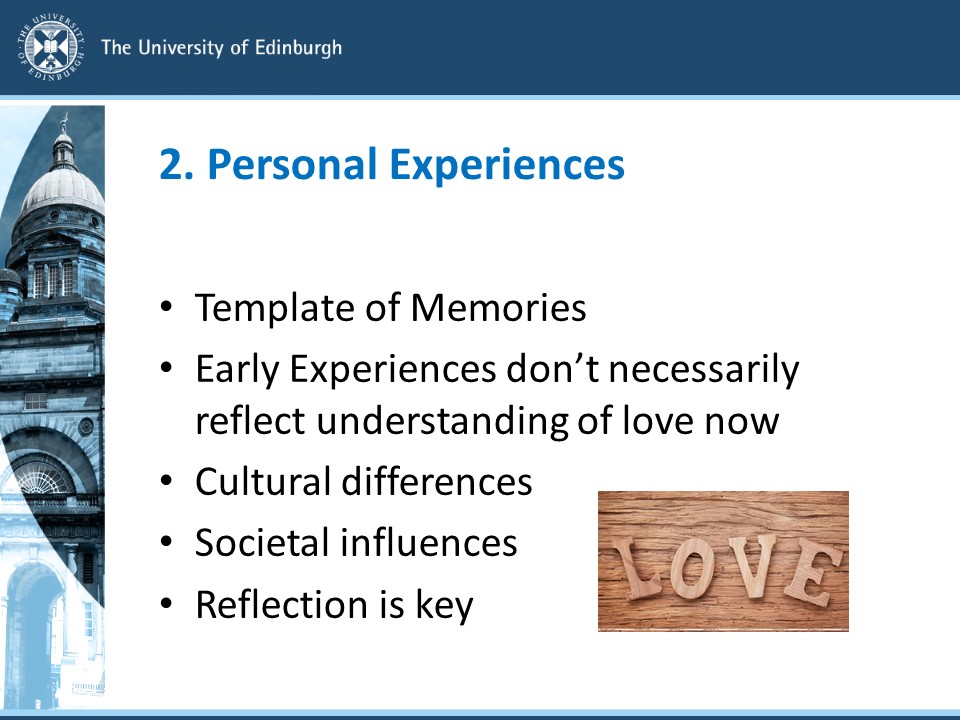
I often think I give these presentations and there is no real record of me doing them so here is the power point from the presentation I gave to the PDA/BA Childhood Practice Providers Group:
My thoughts, and mine alone, on why love matters in Early Childhood Practice. I am interested in how we ensure children experience love when they are in nursery. I am simply searching for some answers.
Monday, 10 June 2019
Thursday, 9 May 2019
Thesis submission and lollypops!
On a beautiful Thursday afternoon in April (18th) I headed up to the College office at the George Square campus of the University of Edinburgh to hand in my PhD thesis. People say things like "five long years...." but it hasn't felt like long years, they have whizzed in and I will be sad to see it finish. However, it was brilliant handing my thesis in.
I went into the office and asked the woman in the office how I went about handing it in. "just give it to me" she said and then she just took it and put it to the side of her desk. She must have seen my "is that it" face and she asked if I would like a receipt. Eagerly I replied I would, something told me she has seen that face many times! And then she produced a big box and said "well done, you have earned yourself a lollipop!". She asked what colour I wanted, then she looked at the title of my thesis and said "aww love, well it has to be a red one doesn't it".
So that was that, thesis finally submitted. I am very,
proud of myself.
I went into the office and asked the woman in the office how I went about handing it in. "just give it to me" she said and then she just took it and put it to the side of her desk. She must have seen my "is that it" face and she asked if I would like a receipt. Eagerly I replied I would, something told me she has seen that face many times! And then she produced a big box and said "well done, you have earned yourself a lollipop!". She asked what colour I wanted, then she looked at the title of my thesis and said "aww love, well it has to be a red one doesn't it".
So that was that, thesis finally submitted. I am very,
proud of myself.
Wednesday, 10 April 2019
Love is a Strong Word - latest blog for Parenting Across Scotland
“Love is a strong word”
Jane Malcolm, University of Edinburgh
On my way into work I was struck by the amount of times I saw the word ‘Love’. Shop windows proclaiming how much you will ‘love’ their products, graffiti love hearts and words of ‘love’ and posters on bus stops sharing stories of love.

We are surrounded by love and take it for granted that it is part of life. So why has it become such a radical thing to discuss in the early learning and childcare sector and indeed the wider care sector? There is a real fear about that tiny little word ‘love’.
In my recent study, http://janeymphd.blogspot.com/ I investigated what the barriers are to working with children and families in a way which is openly loving and professional. Parents in my study told me that they did want their child to be loved when they were at nursery, with one saying “Yes, I want the staff to love my child, I feel they almost take over my role as parent”. Many of the parents repeated this view however there was often the caveat that it was a ‘different’ kind of love. This struggle with defining love was a strong theme in my study, with there being many different definitions, which did not quite always match the situation.
Love is complex. It means different things to different people on different days with different people. However, fundamentally it is an emotional reaction to an interaction with another person. We live in a complicated society which has many, perceived and real dangers, and love is scary. Because of its multiple meanings for people it becomes easier to just not talk about it and instead use alternative words such as ‘compassion’; ‘care’ and ‘nurturing’. Parents shared this reluctance with one saying that while she had never really thought about it, she believed the staff were ‘fond’ of her children and if that translated into ‘love’ then yes she wanted them to love her children.

My study focuses partly on the role of the policy makers in bringing love into the language of early learning and childcare. Many of the practitioners I spoke to told me that while they knew how important love was to the children and families they cared for they felt restricted by the rules. They felt that while the guidelines they work with didn’t really say they were ‘allowed’ to love the children they held back saying they did. The practice is out there – the policies need to change.
The Scottish Government have courageously opened the conversation around how love can be brought into ELC with key expansion policy documents including the word ‘love’. While this can be argued is not enough to change practice and minds it at least starts the conversation. With children being in childcare for 1140 hours the use of this language enables practitioners, who are, I would argue already loving in their practice, the freedom and permission to open the discussion around how love fits in with their professionalism.
Jane Malcolm
Doctoral Student – The University of Edinburgh
@JaneMalcolm7
Friday, 29 March 2019
"some children are too hard to love" and the Nativity Elf!
I haven't written in my blog for a while because I have been carrying out final edits of my thesis! Soon to be submitted.
I have also turned to thinking about writing my key note speech for the ACEL conference in Australia which I am going to in three weeks time. My title is "Some children are too hard to love".
Throughout my research study this is a phrase I kept hearing from childcare practitioners. It is a phrase that worries me because are we saying that there are some children in the world who don't deserve love because of perhaps their behaviour might not be appropriate or somehow challenging. I agree that some children do have challenging and inappropriate behaviours however I also believe that these children are posssibly the children who need love the most!
I am starting my key note speech by introducing the audience to a little boy who I cared for in my playgroup at least 17 years ago, which will make him almost 20 now. I have no idea where he is now, or what he is doing with his life. But at that time he was quite a challenge. He would throw tantrums like I have never seen the likes again. His little body would go rigid with frustration and anger to the point you could carry him like a plank of wood. He would get so angry in his little body that he would lash out and hit walls and scream ear-pearcingly loud. He once was off playgroup because he had broken his nose in one of his tantrums, and an hour back to playgroup after it had healed and he did it again, after flying into a rage.
The staff probably did find him "too hard to love". But I still remember this little boy, and I have kept a photograph of him dressed as that well known Nativity Elf (he wouldn't be in the nativity unless he could be dressed as an elf so that year the baby Jesus was visited by an Elf carrying a toy sheep!). He left his mark on my heart, I often wonder what he is doing with himself now as an adult.
There were many reasons for his challenging behaviour, that I won't go into now but it would have been too easy to find him 'too hard to love'. Despite the hard work, I like to think I showed both him and his family love, I supported them, I went the extra mile. He deserved my love because he was a little boy with a lot of anger and frustration trapped inside his little body. He didn't always understand his huge emotions and struggled with dealing with them. Love is a huge emotion, and often all that little boy needed was a cuddle and some love to calm him down. Holding him until the frustration left his body was what he needed most.
Don't get me wrong, there were days when he drove me to distraction, and I will admit to hoping he would be off when the inspectors came calling, but on the whole he was lovely little boy, who on good days was "really easy to love".
My message is simple, don't write the challenging children off, they are the ones who will really benefit from love.
Now I have the inspiration to go write my speech now!
I have also turned to thinking about writing my key note speech for the ACEL conference in Australia which I am going to in three weeks time. My title is "Some children are too hard to love".
Throughout my research study this is a phrase I kept hearing from childcare practitioners. It is a phrase that worries me because are we saying that there are some children in the world who don't deserve love because of perhaps their behaviour might not be appropriate or somehow challenging. I agree that some children do have challenging and inappropriate behaviours however I also believe that these children are posssibly the children who need love the most!
I am starting my key note speech by introducing the audience to a little boy who I cared for in my playgroup at least 17 years ago, which will make him almost 20 now. I have no idea where he is now, or what he is doing with his life. But at that time he was quite a challenge. He would throw tantrums like I have never seen the likes again. His little body would go rigid with frustration and anger to the point you could carry him like a plank of wood. He would get so angry in his little body that he would lash out and hit walls and scream ear-pearcingly loud. He once was off playgroup because he had broken his nose in one of his tantrums, and an hour back to playgroup after it had healed and he did it again, after flying into a rage.
The staff probably did find him "too hard to love". But I still remember this little boy, and I have kept a photograph of him dressed as that well known Nativity Elf (he wouldn't be in the nativity unless he could be dressed as an elf so that year the baby Jesus was visited by an Elf carrying a toy sheep!). He left his mark on my heart, I often wonder what he is doing with himself now as an adult.
There were many reasons for his challenging behaviour, that I won't go into now but it would have been too easy to find him 'too hard to love'. Despite the hard work, I like to think I showed both him and his family love, I supported them, I went the extra mile. He deserved my love because he was a little boy with a lot of anger and frustration trapped inside his little body. He didn't always understand his huge emotions and struggled with dealing with them. Love is a huge emotion, and often all that little boy needed was a cuddle and some love to calm him down. Holding him until the frustration left his body was what he needed most.
Don't get me wrong, there were days when he drove me to distraction, and I will admit to hoping he would be off when the inspectors came calling, but on the whole he was lovely little boy, who on good days was "really easy to love".
My message is simple, don't write the challenging children off, they are the ones who will really benefit from love.
Now I have the inspiration to go write my speech now!
Friday, 22 February 2019
The Next Generation of Voters quiz the First Minister
FMQ's Next Generation
I have just taken time to watch this special edition of Scotland Tonight with the Next Generation of voters quizzing the First Minister.
The questions the children and young people ask are eloquent, well thought out and informed. It reminds me of how proud I was of Rhona making her own informed choice about whether she wanted to live in an independent Scotland. She took time to listen to all the arguments and then mulled them over in her own mind. She then carefully took her views to the polling station and cast her vote. For her first ever vote, at 16, a privilege of young people living in Scotland, it was an important, life changing one for her.
I was proud Scotland gave her the opportunity to have a say in her own future. These children give our First Minister a grilling, and rightly so! Go the Next Gen!!!
Make a cup of tea and take time out of your day to watch this.
I have just taken time to watch this special edition of Scotland Tonight with the Next Generation of voters quizzing the First Minister.
The questions the children and young people ask are eloquent, well thought out and informed. It reminds me of how proud I was of Rhona making her own informed choice about whether she wanted to live in an independent Scotland. She took time to listen to all the arguments and then mulled them over in her own mind. She then carefully took her views to the polling station and cast her vote. For her first ever vote, at 16, a privilege of young people living in Scotland, it was an important, life changing one for her.
I was proud Scotland gave her the opportunity to have a say in her own future. These children give our First Minister a grilling, and rightly so! Go the Next Gen!!!
Make a cup of tea and take time out of your day to watch this.
Wednesday, 23 January 2019
25 Calls - Children in Scotland
To celebrate their 25th anniversary Children in Scotland presented 25 Calls to change children's lives for the better. 25 Calls is about sharing Scotland’s hopes and ambitions for future generations and achieving real change.
A call went out for responses to each call and I asked if I could respond to one of the calls. The call I chose to respond to was Call 17 https://childreninscotland.org.uk/call-17-prioritise-integration-support-for-families-and-participation-to-give-children-the-best-start/
I was absolutely delighted to have my blog response accepted and here it is:
https://childreninscotland.org.uk/25-calls-response-services-underpinned-by-love-for-all-children/
Please take time to read the other calls. Ensuring children's lives get better should be at the heart of everything we do for children.
Friday, 11 January 2019
Policy leads practice - Why we have to get it right!
I picked up a tweet on
Friday 11 Jan https://twitter.com/suzannezeedyk/status/1083637607240744961.
The article Suzanne was commenting on was a blog by Mona Delahooke, PhD https://www.MONADELAHOOKE.COM. In her blog Mona tells a story about the experience of young boy who has autism. She says:
"Not long ago, at an autism treatment forum, I heard about a painful and frustrating episode a teenager recalled from his childhood. At five years old, the boy was 45 minutes into an autism treatment session when he ran to the window, pressed his nose against it, and stared intently at the family car. Unable to use spoken language or even point or gesture, he was simply trying to express to his behaviour therapist and his mother that he was weary of the incessant drills and ready to go home.
The therapist didn't get the message, dismissing his attempt to communicate as mere "stimming" - that is, a form of meaningless self-stimulation. "he's fixating on the care", she told the boy's mother. "Let's just ignore and try to get him back to the table". Now the boy recalls his great frustration trying to make himself understood.
The therapist wasn't being intentionally harsh. She was merely following an autism treatment protocol that uses reinforcement and other strategies such as "planned ignoring" to help children with autism learn and acquire new, adaptive behaviours."
Mona continues in her blog to discuss the hidden costs for this commonly used tool for the young person, however for me this is another example of how policy, guidelines and procedures lead practice.
I don't doubt for one moment that the therapist in this example felt she was doing absolutely the right thing for the family. I had never heard of planned ignoring, however as I have never worked directly with a child on the autistic spectrum, only supported families and staff through the nursery, it is not unusual that I would not have heard of it, Suzanne Zeedyk herself said the same. So a quick internet search revealed that "planned or tactical ignoring is a strategy where you give no outward sign of recognising a behaviour (e.g. no eye contact, no verbal response, no physical response). However, you are aware of the behaviour occurring, and you monitor the child to ensure their safety and the safety of others. Often, you will be able to continue with a conversation with others without acknowledging the attention-seeking behaviour" http://www.autism-help.org/behavior-tactical-ignoring-autism.htm. For me this is as far from loving, caring practice as you could get.
My limited experience working with children and adults with autism has taught me that their behaviours often represent communication. I worked with a young woman, who was on the autistic spectrum, who held a soft toy in class. When she would become uncomfortable or uneasy about something she would begin to pull quite vigorously at the limbs of this toy. Her behaviour was distracting and often alarming for others in the class but to ignore this behaviour would have been wrong, she was telling me she was unhappy. To support her and to show I was listening to her and to maintain her sense of dignity, we arranged that I would simply go up to her and lay down a flower shaped eraser (we agreed this was her chosen signal). This signal told her silently, without fuss, that I understood she was uncomfortable and needed to leave this difficult situation. She would then leave my class and go to find her learning development tutor. Had I just ignored this behaviour, she probably would have quietened down, but she would have felt frustrated, not listened to and unloved. This was not written into any guidelines but I used my knowledge and experience to know that for this young woman this was the most loving thing I could do for her.
Mona makes the point that one of the hidden costs of this practice are that it sends "the wrong emotional message to the child. In short, the adult is saying "I'm not interested in what you are trying to convey, and I'll pay attention only when you comply with my demands". As the young man in the example above shows he still recalls frustration at not being understood. The therapist was following guidelines, guidelines which will have been developed following policy created at a much higher level. There is nothing wrong with this process, however in order for the practice to not cause this kind of harm to young people as they grow and develop it is crucial that the policies reflects practice which is enabling rather than restricting. This therapist should have had the freedom to use their own knowledge, understanding, experience and learning to work with each child in a loving and individual way. While a child on the autistic spectrum may not be able to recognise or acknowledge love they will recognise when someone is working in a loving manner.
Getting the language right in the initial policies will underpin practice guidelines and protocols in a way that allows the practitioner to work in a professional way which allows them freedom to work with integrity and know they have cared for the child, young person or adult in a way which represents their own values.
That being said, as Mona points out this doesn't mean there won't be occasions where ignoring unwanted behaviours isn't the right thing to do however, ensuring the guidelines practitioners work with aren't restricting them to carry out practice that may not be right for the child is the key to good practice.
Friday 11 Jan https://twitter.com/suzannezeedyk/status/1083637607240744961.
The article Suzanne was commenting on was a blog by Mona Delahooke, PhD https://www.MONADELAHOOKE.COM. In her blog Mona tells a story about the experience of young boy who has autism. She says:
"Not long ago, at an autism treatment forum, I heard about a painful and frustrating episode a teenager recalled from his childhood. At five years old, the boy was 45 minutes into an autism treatment session when he ran to the window, pressed his nose against it, and stared intently at the family car. Unable to use spoken language or even point or gesture, he was simply trying to express to his behaviour therapist and his mother that he was weary of the incessant drills and ready to go home.
The therapist didn't get the message, dismissing his attempt to communicate as mere "stimming" - that is, a form of meaningless self-stimulation. "he's fixating on the care", she told the boy's mother. "Let's just ignore and try to get him back to the table". Now the boy recalls his great frustration trying to make himself understood.
The therapist wasn't being intentionally harsh. She was merely following an autism treatment protocol that uses reinforcement and other strategies such as "planned ignoring" to help children with autism learn and acquire new, adaptive behaviours."
Mona continues in her blog to discuss the hidden costs for this commonly used tool for the young person, however for me this is another example of how policy, guidelines and procedures lead practice.
I don't doubt for one moment that the therapist in this example felt she was doing absolutely the right thing for the family. I had never heard of planned ignoring, however as I have never worked directly with a child on the autistic spectrum, only supported families and staff through the nursery, it is not unusual that I would not have heard of it, Suzanne Zeedyk herself said the same. So a quick internet search revealed that "planned or tactical ignoring is a strategy where you give no outward sign of recognising a behaviour (e.g. no eye contact, no verbal response, no physical response). However, you are aware of the behaviour occurring, and you monitor the child to ensure their safety and the safety of others. Often, you will be able to continue with a conversation with others without acknowledging the attention-seeking behaviour" http://www.autism-help.org/behavior-tactical-ignoring-autism.htm. For me this is as far from loving, caring practice as you could get.
My limited experience working with children and adults with autism has taught me that their behaviours often represent communication. I worked with a young woman, who was on the autistic spectrum, who held a soft toy in class. When she would become uncomfortable or uneasy about something she would begin to pull quite vigorously at the limbs of this toy. Her behaviour was distracting and often alarming for others in the class but to ignore this behaviour would have been wrong, she was telling me she was unhappy. To support her and to show I was listening to her and to maintain her sense of dignity, we arranged that I would simply go up to her and lay down a flower shaped eraser (we agreed this was her chosen signal). This signal told her silently, without fuss, that I understood she was uncomfortable and needed to leave this difficult situation. She would then leave my class and go to find her learning development tutor. Had I just ignored this behaviour, she probably would have quietened down, but she would have felt frustrated, not listened to and unloved. This was not written into any guidelines but I used my knowledge and experience to know that for this young woman this was the most loving thing I could do for her.
Mona makes the point that one of the hidden costs of this practice are that it sends "the wrong emotional message to the child. In short, the adult is saying "I'm not interested in what you are trying to convey, and I'll pay attention only when you comply with my demands". As the young man in the example above shows he still recalls frustration at not being understood. The therapist was following guidelines, guidelines which will have been developed following policy created at a much higher level. There is nothing wrong with this process, however in order for the practice to not cause this kind of harm to young people as they grow and develop it is crucial that the policies reflects practice which is enabling rather than restricting. This therapist should have had the freedom to use their own knowledge, understanding, experience and learning to work with each child in a loving and individual way. While a child on the autistic spectrum may not be able to recognise or acknowledge love they will recognise when someone is working in a loving manner.
Getting the language right in the initial policies will underpin practice guidelines and protocols in a way that allows the practitioner to work in a professional way which allows them freedom to work with integrity and know they have cared for the child, young person or adult in a way which represents their own values.
That being said, as Mona points out this doesn't mean there won't be occasions where ignoring unwanted behaviours isn't the right thing to do however, ensuring the guidelines practitioners work with aren't restricting them to carry out practice that may not be right for the child is the key to good practice.
Subscribe to:
Posts (Atom)
MPhil Thesis - Love, Policy and Professionalism:The Early Learning and Childcare Lead Professional
I was awarded a Master of Philosophy for my research project in November 2022. While I am disappointed it wasn't a doctorate, I am happ...
-
We find ourselves in very strange times at present. A deadly virus is spreading through the world almost faster than we can deal with it. In...
-
I often think I give these presentations and there is no real record of me doing them so here is the power point from the presentation I gav...
-
May 2019 Sydney, Australia Australian Council for Educational Leaders Early Years Conference. You don't get much more iconic t...